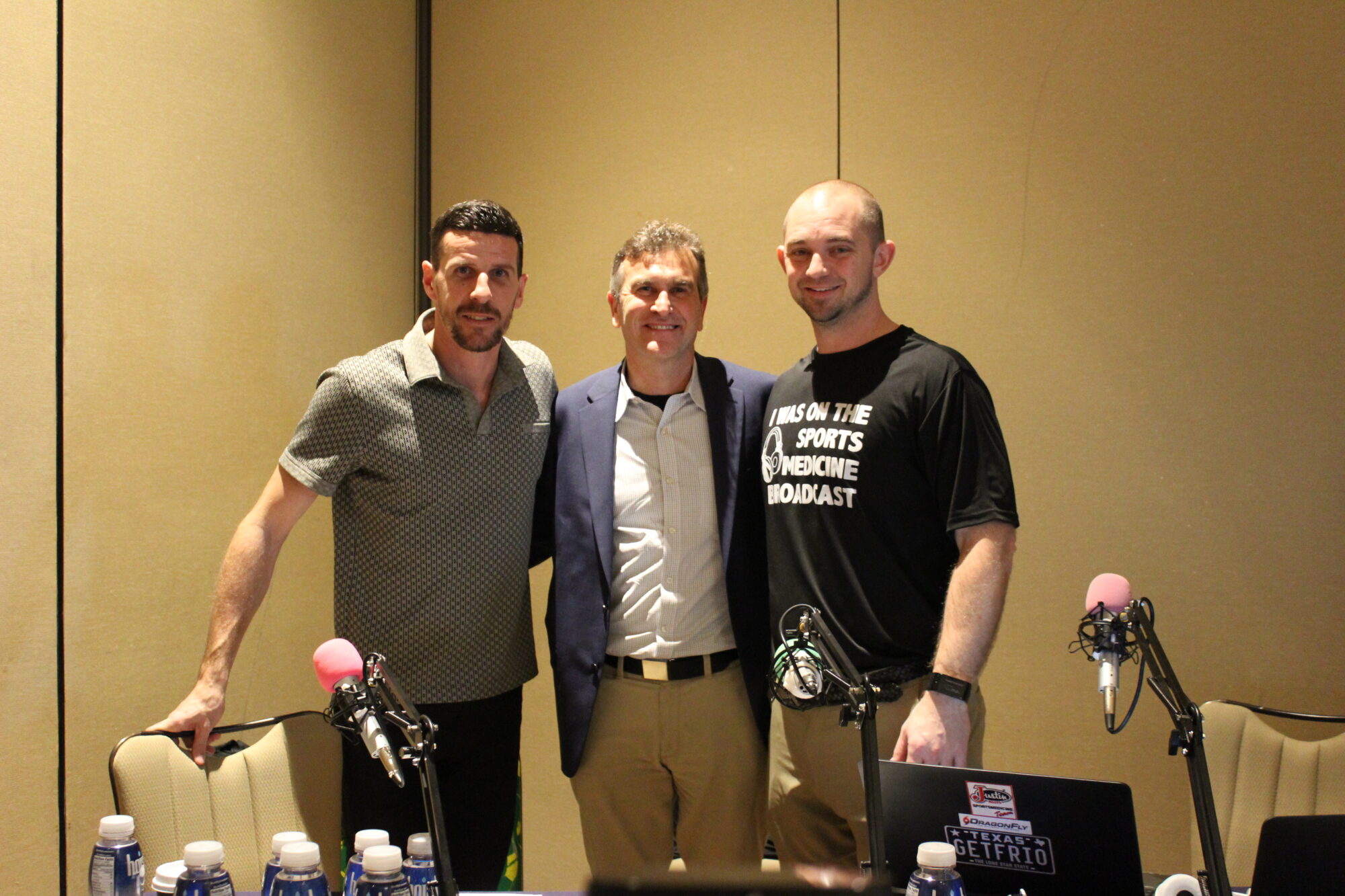
200 Episodes of Sports Medicine Content

WOW, what an amazing fast paced show.  30 minutes is really fast.  We had a lot of fun and gave away some really cool stuff thanks to some really awesome people.

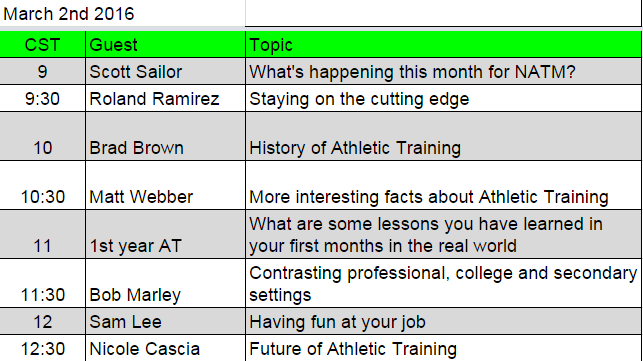
Here is the full list of guests and topics.  This episode is long but very entertaining.

About every half hour we switched guests if you want to jump ahead to one then think in roughly 30 minute blocks.

200 schedule of guests

It will also start the NATM with a bang since we are running about 15 shows this month.


Sub-Symptommatic Post-Concussion Exercise – 199

National concussion authority Dr. Summer Ott, PhD brings Chris Shields, DPT to discuss a relatively new treatment option for concussions that are taking extended periods of time.  Keeping the heart rate below 60% of the max HR can improve patient function and help them move towards normalizing.

Discussion topics:
Contact Chris Shields
Twitter: @PHSSportsMed

When Athletic Trainers Get Injured – 198

Each of us knows what to do when there is an ankle sprain, broken femur or torn ACL: call the athletic trainer.  What happens when that injury is the Athletic Trainer?
Mike Overman – tib fib fracture
Jesse Lopez – ACL tear
Jeremy Jackson – Knee hyperextension
Hear the story of our injuries, what we did to treat ourselves, evaluate ourselves and rehab ourselves (seems to be a theme here).  Laugh with us as we discuss everything related to the process.
Discussion topics:
Contact Mike Overman
Contact Jesse Lopez
Twitter: @PHSSportsMed

Find Out Why You Should Use Ankle Braces – 197

   or   
Brett McQueen is a research nerd.  He enlightens us on some of the most current data supporting using tape and the support for using a brace.
Discussion topics:

Tell us about some of the research you have been studying of in regards to bracing or taping
What different variables did you look at in taping?
How about bracing?
How can you create a control for an ankle taping
How has this information been received athletic trainers, Coaches / Parents?
Where there any style or brand recommendations for braces?
What can we do to help spread the current understanding of the brace tape argument?

Contact Brett McQueen:
Twitter: @bmcqueen42
Twitter: @PHSSportsMed

Athletic Training On-Demand: Does it Help or Hurt -196

alisha

Where there is a need there is a business opportunity.  Alisha Pennington saw Athletic Trainers needed help getting jobs and that schools need Athletic Trainers.  Working in a state that does not protect or place a huge emphasis on Athletic Trainer is a challenge that needed to be taken on.  She has developed her company to solve that disconnect between athletic trainers and schools
Discussion topics:

Alisha's athletic training story
Tell us a little about ATVantage
What is your hope or goal for the business?
What do you see as some potential drawbacks for hiring athletic trainers this way?
What are the top benefits for working this way?
How does the lack of title protection in California  affect Athletic Training
What can we do to help justify more hours / additional help

Twitter: @PHSSportsMed

Biceps Tendinitis a Neurological Case study approach – 195

Here is the scenario:

  • 17 year old female volleyball player
  • plays club and school alternating seasons
  • no other sports
  • Pain in anterior shoulder
  • go through normal muscle eval
  • pain on Speed’s test
  • pain with Yergason’s

Start with heat and ROM exercises
Progress to body weight exercises
Then to t-band exercises

Pain free return to play in about 4 weeks

There are lots of other treatment types we did not do, and likely some evaluations we forgot.  One way to improve is to look back, but here we do it with the help of some of my friends and injury experts.

Contact Josh Ogden
Email:

Contact Mike McKenney
Email:

Show Notes 195

email me: info@sportsmedicinebroadcast.com

Don't forget to register to win gift cards from Sports Health


  • Tri-Planar performance above T8 requires stability and control of sagittal and frontal plane movements at the pelvis/hip (below T8)
  • Scapular position is directly related to orientation of Rib-cage over pelvis
  • Finding reference centers for landing mechanics
  • Fatigue
  • Lack of Upper thoracic movement variability (need Subscap/Serratus/Low Trap)
  • TRICEP facilitation
  • In the air, you shoulders become your hips, you need controlled mobility
  • Thoracic mobility is essential for overhead motion
  • Pec inhibition
  • Is it really bicep tendonitis?
    • Differential Diagnoses:
      • Thoracic Outlet Syndrome
      • Rotator Cuff/Supraspinatus
      • Deltoid
      • Trigger/Tender point referral pattern from infraspinatus/anterior deltoid
      • Scap Dyskinesis w/compensatory HG IR = “impingement”?
      • etc.
    • Concurrent findings:
      • Overall Hx
      • Overall tension (e.g. chronic upper trap contraction)
      • Breathing patterns esp. c/restriction upper R chest?
        • Neck breather w/rib cage elevation?
      • Overall posture
        • Slumped shoulders?  Kyphotic?  Lordotic? etc.
        • Forward head/posterior rotated head posture?
        • Shoulder height variance?
      • Spinal rotation/curvature
      • Rib cage/thoracic positioning & mobility
      • Pelvic stability?
      • FA IR/ER & Flex limitations?
    • Imaging – Musculoskeletal US or Arthrogram?
    • Injections?  Relief or no?
  • Treatment (I use PRI techniques mixed with a lot of traditional techniques, but use whatever you have in your toolbox)
    • Frontal Plane control thru pelvis and Transverse plane control thru thorax
    • Rib cage mechanics
      • Breathing pattern retraining (or manual techniques) as needed to restore IR/ER & remove restrictions
    • Restore thoracic rotation
    • Improve Scap Positioning
      • Inhibit Pecs, lats, upper traps, etc. as needed
        • Pec minor involvement?
      • Low Trap & Tricep First
      • Serratus Anterior
        • Make sure scap is moving on thorax due to SA activation, NOT Pec activation
          • SA moves scap on thorax
          • Pec reinforces anterolateral tilt
      • Subscapularis
      • Contralateral side
        • Low Trap/Tricep
        • SA
        • Subscap
        • No injury is unilateral.  Rehabilitate bilaterally.
          • Compensatory thoracic rotation, pelvic obliquity, etc. needs to be addressed.
  • RTP considerations
    • Hitting program
      • Pay attention to core engagement with hitting
      • Flying open into extension reduces scap control
    • Jumping program
      • Poor jump mechanics places the arm in a poor hitting position before the arm motion even starts
      • Poor landing mechanics increase injury risk as well as neurological apprehension = decreased power output and increased stress on LHBT, Cuff, etc.


Finding What Hurts: Tips from Pediatrician Dr. Amy – 194

Dr. Amy Christen-Huhn is my family pediatrician.  Communicating with patients who lack vocabulary to articulate what hurts and when is a mandatory skill for her job.  We plan to learn tips and tricks to ask better questions and get better answers from our patients.

A few of her tips are:

Gain trust
Start on the unaffected side
Use distraction
Make questions relate to them
Use one finger
Watch them move

Email Dr. Amy

Show Notes 194

email me: info@sportsmedicinebroadcast.com

Don't forget to register to win gift cards from Sports Health

Alaskans Make Great Athletic Trainers Too – 193

09-07_APR32461
Alaskan Snow

Chris Dean, President of Alaska Athletic Trainer Association, shares experiences of working in Alaska as an Athletic Trainer.

We discuss:
Best and worst parts of working in Alaska;
Unique sports or treatment remedies;
Ways they are improving and promoting Athletic Training in Alaska;
Insider tips on dealing with cold weather;
Polar Bears at Football Practice
Moose Crossings
-60 degree weather

Show Notes 193

Contact Chris: cdean@sportsmedicinefairbanks.com


Image reference: http://www.skolaiimages.com/journal/tag/sports/


How to treat and manage injuries in Soccer – 192

Soccer season often produces as many injured athletes as football season.  To gear up we are speaking with some of the best Athletic Trainers in soccer.

Dawn Stuckey – Rice Owls
Theron Enns – Houston Dynamo
Bobby Wisenberger – Charleston Battery

Topics:
What are preventable injuries in soccer and how can we prevent them?
Best practices for rehabbing Soccer injuries
Top tips for preventing and treating cramps
Sports specific rehab

Show Notes 192