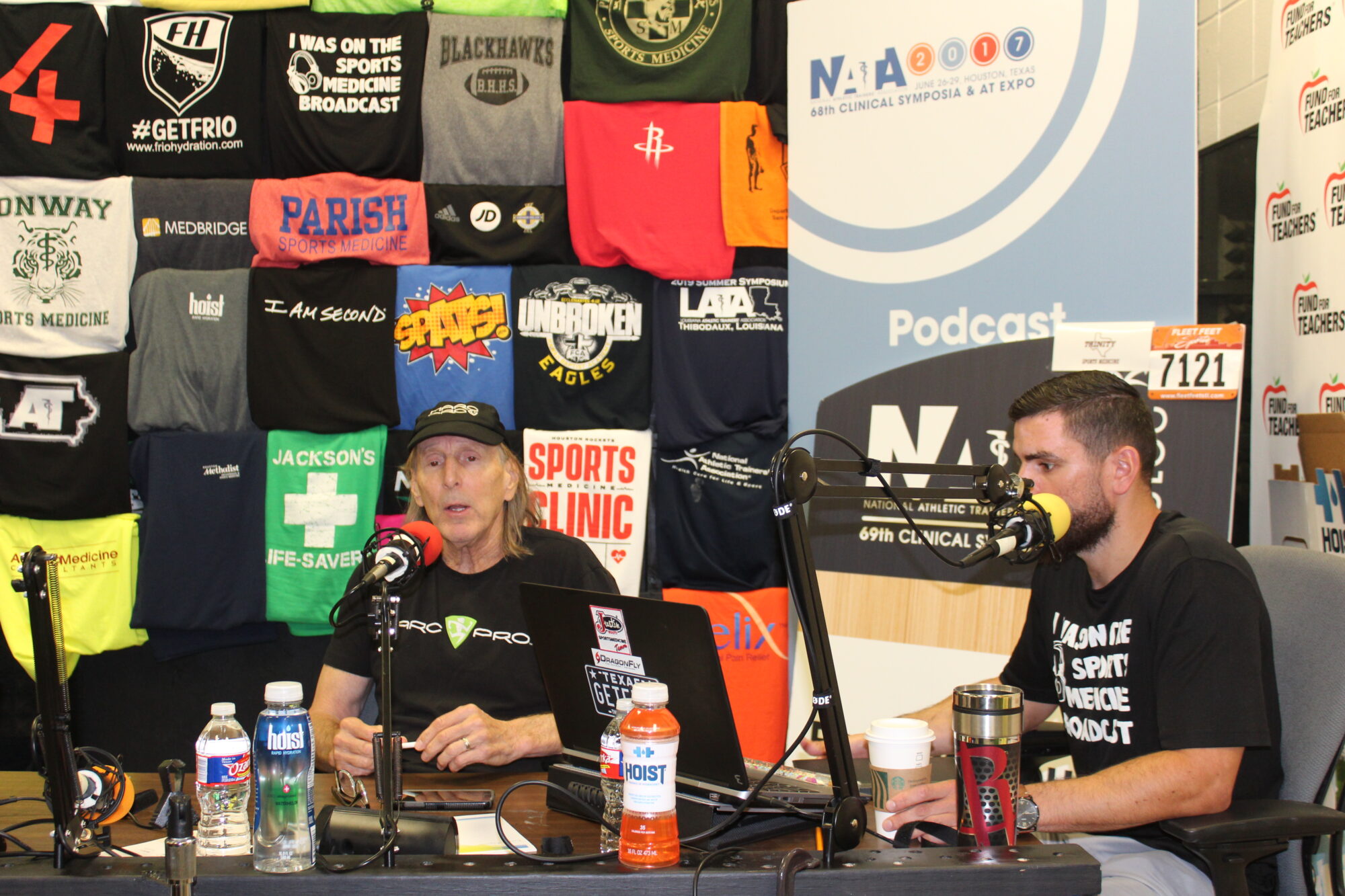
Working Around Upper Extremity Injuries: Maximizing Athletic Potential in Rehab

Sports Medicine Broadcast

A Podcast to Promote and Improve Your Practice as an Athletic Trainer

When an overhead or rotational athlete—such as a baseball pitcher, softball player, volleyball server, or tennis player—suffers a significant upper extremity injury, traditional care often calls for shutdown periods lasting anywhere from six weeks to several months. While restricting arm motion is crucial for surgical or tissue healing, completely shutting down the athlete can lead to lost athleticism, decreased conditioning, and a difficult return-to-play process.

In this episode of the Sports Medicine Broadcast, host Chase Morales is joined by Cathy Nguyen, Xavier Porter, and physical therapist Ryan Collins to dive into strategies for keeping overhead athletes conditioned and engaged while protecting healing shoulder and elbow tissues.

Training Beyond the Injured Arm

Overhead performance relies heavily on total-body coordination, trunk rotation, and lower-body ground reaction forces. When the arm is immobilized or restricted, clinicians have a valuable window to address other components of the kinetic chain:

  • Lower Quarter & Ground Forces: Maintaining single-leg strength, lower-body power, and leg drive so the athlete does not lose the foundation of their throwing or hitting mechanics.
  • Trunk & Core Rotation: Safe, controlled hip and trunk rotation work keeps the core responsive and strong without placing mechanical stress across the healing arm.
  • Cardiovascular Conditioning & Movement: Avoiding long periods of inactivity prevents overall physical decline and eases the physical transition back to sport-specific drills.

Protocols Are Templates, Not Rigid Rules

Standard rehabilitation protocols for procedures such as SLAP repairs, UCL reconstructions, or rotator cuff repairs are designed around histology—how tissue heals over specific timeframes. While respecting these tissue-healing boundaries is mandatory, Collins points out that protocols should serve as adaptable templates rather than rigid, calendar-only directives:

  1. Avoid Automatic Time-Based Progression: Moving an athlete to the next phase purely because a calendar week has passed can overload tissues that are not yet ready or flexible enough.
  2. Prevent Monotony & Stagnation: Relying solely on basic wrist curls, passive stretching, or light band work for weeks can lead to boredom and sloppy execution. Challenging athletes safely keeps their buy-in high.

Key Progression Criteria Before High-Velocity Loading

Before introducing plyometrics, medicine ball throws, or return-to-throwing protocols, clinicians should look beyond simple pain ratings:

  • Full Mobility & Range of Motion: Ensure full structural motion is established without compensatory mechanics.
  • Baseline Controlled Strength: “If you can't do it slow, you definitely can't do it fast”. Validate that slow, controlled movements (e.g., standard push-ups or consistent band resistance) are well-tolerated before attempting explosive tasks.
  • Movement Coordination & Quality: Verify that the athlete can properly sequence their core and hips without substitute patterns that increase inflammation or stress nearby joints.

By viewing rehabilitation as an ongoing part of athletic training, sports medicine professionals can ensure that sidelined athletes return to the field fully prepared, strong, and confident.

Speaker Contact Information

  • Guest: Ryan Collins, PT, ATC
  • Email: Ryan.Collins@memorialhermann.org

Episode Credits

  • Host: Chase Morales
  • Audio Engineer: Shelby Gaytan
  • Equipment Provided By: Russell Sadberry
  • Recording Made Possible By: Bob Marley and the Memorial Hermann Rockets Sports Medicine Institute team

YouTube Presentation: https://youtu.be/D4l77KKSfkU

Addressing Faulty Throwing Mechanics: Biomechanics, Sequencing, and Injury Risk

A Podcast to Promote and Improve Your Practice as an Athletic Trainer

In a recent episode of the Sports Medicine Broadcast, host Chase Morales, along with Ross Little and second-year M.A. student Dorothy Bailey, sat down with Dr. Craig Garrison, Director of Research and Education at the Memorial Hermann Rockets Sports Medicine Institute. Dr. Garrison shared critical insights on identifying and correcting faulty throwing mechanics, understanding the biomechanical drivers of modern throwing velocity, and implementing practical strategies to protect overhead athletes across sports.

The Evolution of Velocity and Biomechanics

In today's sports landscape, throwing velocity serves as the baseline measuring stick for recruitment and advancement. High school baseball pitchers striving for Division I recruitment are now expected to consistently throw in the low-to-mid 90s—a notable contrast to a decade ago when lower velocity ranges were far more common.

This rise in velocity is heavily linked to advancements in biomechanical evaluation and motion analysis technology. By leveraging data-driven insights, clinicians and strength coaches can optimize kinetic sequencing, helping athletes generate explosive power while aiming to mitigate tissue stress.

Kinetic Principles Beyond Baseball

Although baseball pitching dominates discussions around overhead biomechanics, the core mechanical principles extend across multiple disciplines. Dr. Garrison highlighted that track and field throwers—specifically javelin athletes—exhibit nearly identical mechanical principles and injury risk profiles:

  • Force Generation: Throwers must produce substantial force through their drive limb and transition efficiently onto their stride limb.
  • Energy Transfer: Force generated from the ground must be transferred sequentially up the kinetic chain into the upper extremity.
  • High-Stress Breakdown: Flaws in timing or force transfer place extreme stress across the elbow joint, frequently leading to UCL tears, shoulder pathologies, and Tommy John surgeries in both baseball pitchers and javelin throwers.

Balancing Force Production and Kinematic Sequencing

To lower injury risk, clinicians must evaluate both force production and kinematic sequencing. An athlete who produces exceptional lower-body force but lacks proper sequencing will experience high stress on the upper extremity, drastically increasing injury risk.

Mechanical FactorPrimary FunctionClinical & Training Focus
Lower Extremity PowerForce generation from the groundSquats, jumps, explosive lower-body force production
Kinematic SequencingTransferring force up the kinetic chainAuditory cueing, rhythm drills, metronome synchronization
Workload & Load ManagementControlling cumulative joint fatigueTracking pitch counts, training volume, and day-to-day loads

Actionable Strategies for Athletic Trainers and Physical Therapists

When designing rehabilitation protocols or performance programs for young overhead throwers, focus should remain on foundational movement rather than isolated arm exercises.

1. Build Power from the Legs

Forces delivered at ball release originate in the lower body. Training should prioritize lower extremity power, squat performance, and jumping mechanics. The upper extremity primarily serves as the vehicle for delivering the force generated by the legs and core.

2. Implement External Auditory Cueing

Because a baseball pitch is delivered in approximately 250 milliseconds, the human brain cannot consciously process complex internal mechanical adjustments mid-throw.

To overcome this, Dr. Garrison advocates for external cueing using simple tools like a metronome:

  • Match the metronome tempo to the athlete's desired pitching tempo.
  • Align the initial beat with stride-foot contact and the subsequent beat with the point of ball release.
  • Allow the athlete's central nervous system to self-organize and adjust rhythm naturally through auditory cues, eliminating conscious overthinking.

Managing Athlete Capacity and Gaining Buy-In

Addressing biomechanics effectively also requires managing realistic athlete capacities and behavioral compliance:

  • Understanding Movement Capacities: Neuromuscular coordination and movement capacity vary significantly. Clinicians and coaches must occasionally lead candid conversations with parents and young athletes regarding individual physical limits and ceiling potential.
  • Overcoming the Compliance Barrier: Healthy youth athletes often struggle to appreciate subtle mechanical adjustments. Buy-in generally increases following an injury or through proactive coaching and parental reinforcement.

Summary & Guest Information

Addressing throwing mechanics requires a comprehensive approach that prioritizes lower-body force generation, external timing cues, and careful workload management.

  • Guest: Dr. Craig Garrison (Director of Research and Education, Memorial Hermann Rockets Sports Medicine Institute)
  • Contact Email: Craig.Garrison@memorialhermann.org
  • Episode Link: sportsmedicinebroadcast.com/faultymechanics

YouTube Presentation: https://youtu.be/FGm5caSDJDg